Grok 음성 21종 추가, 이번엔 ‘내 목소리’ 복제까지
챗봇 경쟁이 텍스트에서 음성으로 옮겨가는 흐름이 이번 주 유독 뚜렷했어요. OpenAI가 GPT-Live를 내놓은 것과 비슷한 시기에, xAI도 Grok Voice에 신규 음성 21종과 커스텀 보이스 클로닝 기능을 함께 발표했어요.
핵심 요약
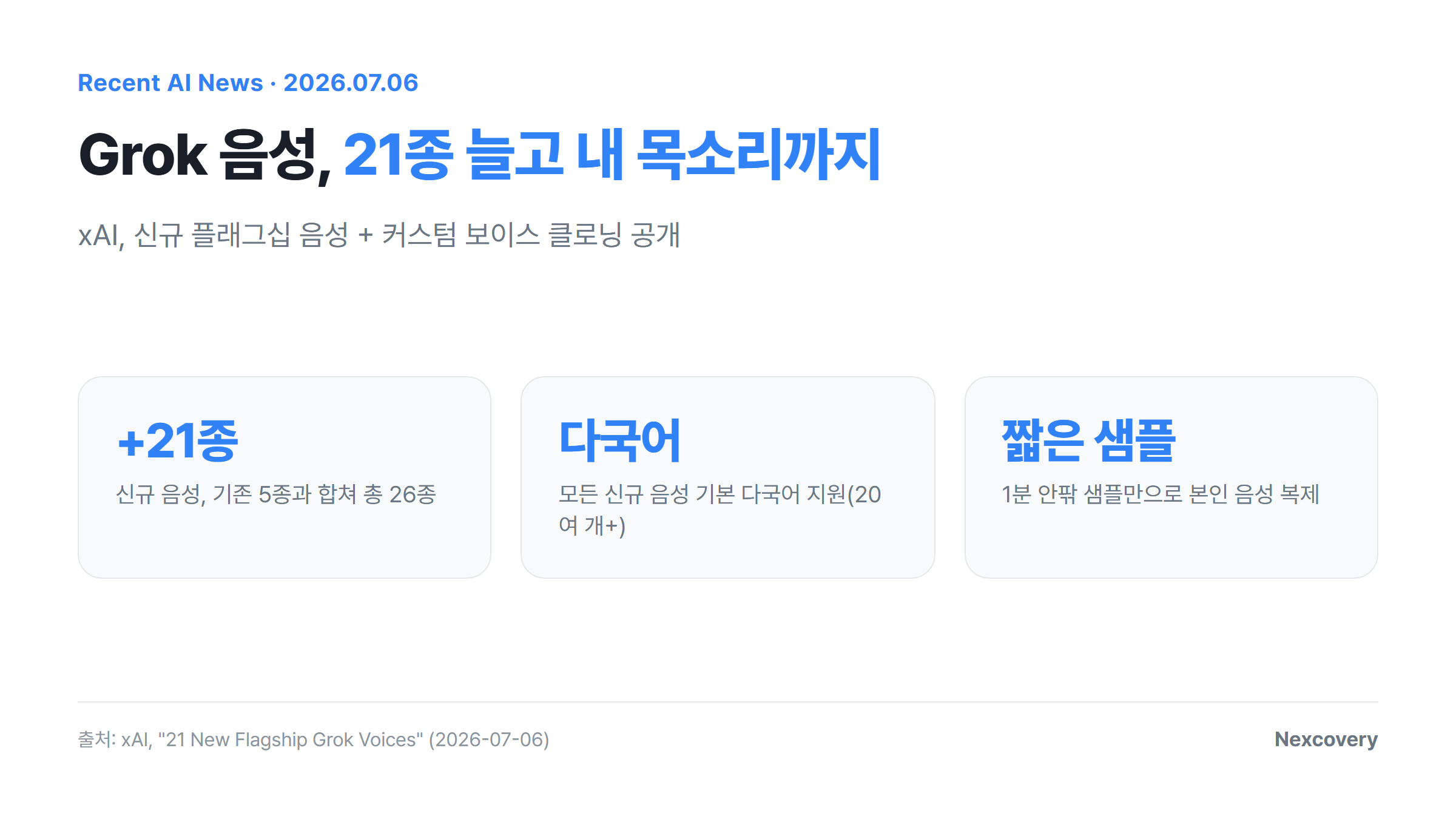
- xAI가 Grok Voice에 신규 음성 21종을 추가했어요(보도 기준 7월 6일 또는 7일). 기존 5종(Ara, Eve, Leo, Rex, Sal)과 합쳐 총 26종으로 늘었습니다.
- 새 음성은 모두 기본적으로 다국어를 지원해요. 지원 언어는 25개 이상으로 안내됐고요(매체별로 20개 안팎이라는 표기도 있어 정확한 개수는 확인이 더 필요해요).
- 각 음성은 고객 지원, 캐릭터, 해설, 광고, 교육 등 쓰임새에 맞춰 캐스팅됐다고 소개됐어요.
- 커스텀 보이스 클로닝 기능도 함께 나왔어요. 짧은 음성 샘플(보도마다 약 1분에서 최대 120초까지로 표현이 갈려요)만으로 본인 목소리를 복제할 수 있어요.
- 신규 음성과 클로닝 기능 모두 Realtime Voice Agent API, Text to Speech API, 신규 Voice Agent Builder에서 바로 쓸 수 있어요.
Grok Just Added 21 Voices — And Now It Can Clone Yours Too
The shift from text to voice as the next chatbot battleground was hard to miss this week. Around the same time OpenAI shipped GPT-Live, xAI rolled out 21 new voices for Grok Voice alongside a custom voice-cloning feature.
TL;DR
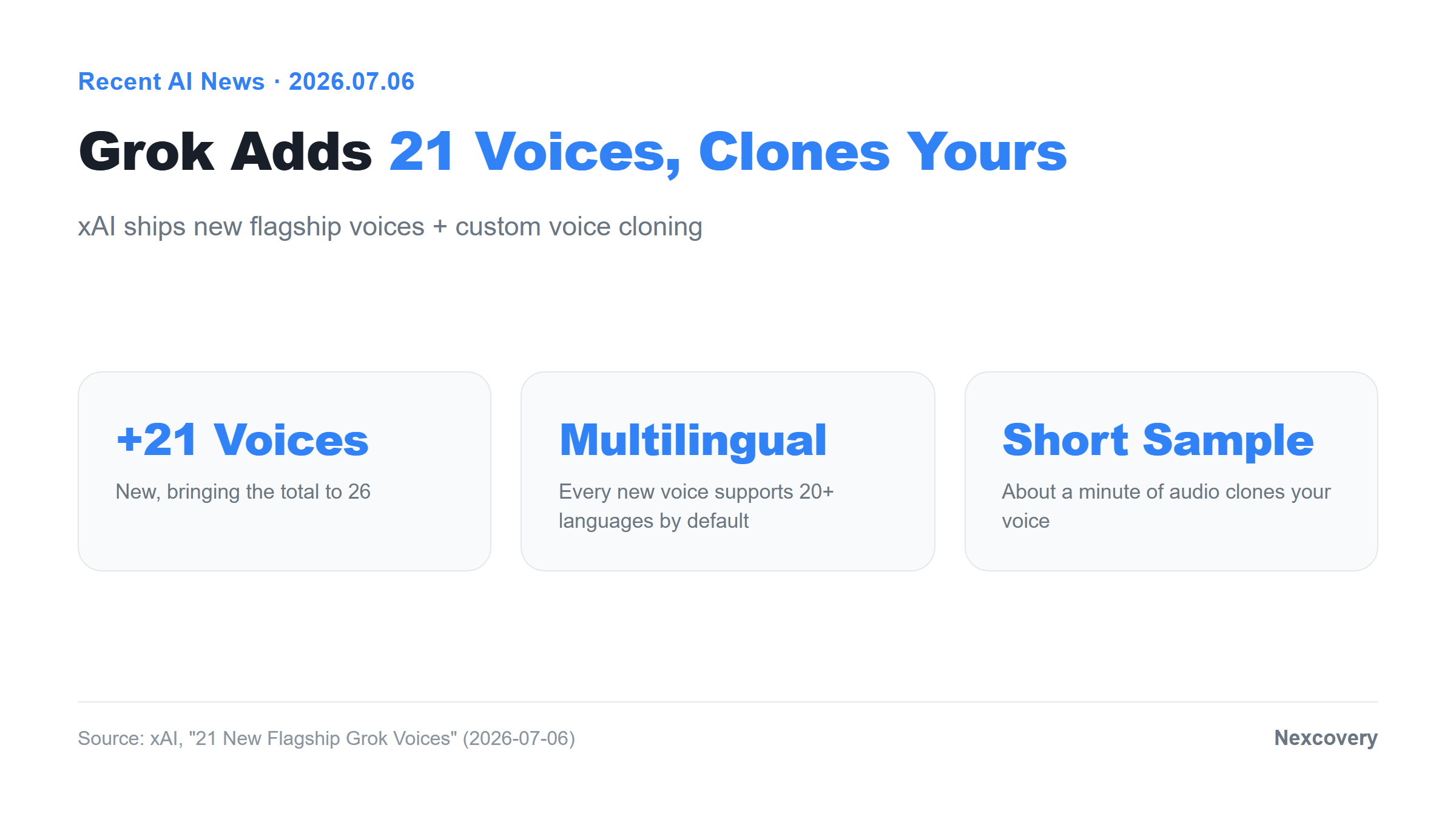
- xAI added 21 new voices to Grok Voice (reported as July 6 or 7), bringing the total to 26 alongside the existing five (Ara, Eve, Leo, Rex, Sal).
- Every new voice is natively multilingual, reportedly supporting 25+ languages (though some outlets cite a lower figure closer to 20, so the exact count needs more confirmation).
- Each voice is described as cast for a specific use case — support, characters, commentary, advertising, education.
- A custom voice-cloning feature also launched. Reports vary on the exact requirement, from as little as one minute to reference clips up to 120 seconds.
- Both the new voices and cloning are available immediately through the Realtime Voice Agent API, the Text to Speech API, and a new Voice Agent Builder.
구조화 분석
21종 음성, 그리고 ‘플래그십’이라는 말의 의미
이번 발표에서 xAI가 강조한 표현은 “플래그십(flagship)“이었어요. 모든 신규 음성이 처음부터 다국어를 지원하도록 설계됐다는 뜻이에요. 보도에 인용된 신규 음성 이름 중에는 Carina, Zagan, Helix, Orion, Luna 같은 이름들이 있는데, 각 음성이 특정 용도에 맞춰 만들어졌다고 소개됐어요. 예를 들어 Carina는 고객 서비스에 어울리는 부드럽고 공감적인 톤으로, Luna는 일반 대화에 맞는 따뜻하고 친근한 특성으로 소개됐다고 해요(테크 매체 보도 기준). 기존에 있던 다섯 음성(Ara, Eve, Leo, Rex, Sal)도 이번에 다시 훈련돼 말의 속도와 억양, 강조가 더 자연스러워졌다고 여러 매체가 전했어요.
발화에 감정과 리듬을 넣는 스피치 태그 기능도 확장됐어요. 일시 정지, 웃음, 숨소리, 속삭임, 음량·음높이·속도 변화, 노래하기 같은 표현을 텍스트 태그로 지정할 수 있다는 설명이에요. 음성을 그냥 읽어주는 수준을 넘어, 연기하듯 표현을 조절하는 방향으로 가고 있는 거예요.
내 목소리 복제, 어떻게 작동하고 뭘로 안전을 지키나
가장 눈에 띄는 기능은 커스텀 보이스 클로닝이에요. 짧은 음성 샘플만 주면 그 사람의 목소리로 말하는 음성을 만들 수 있어요. 이 기능 자체가 이번이 처음은 아니거든요. xAI는 지난 5월 Grok 4.3을 출시하면서 보이스 클로닝을 먼저 선보였고, 그때 2단계 동의 확인 절차를 공개했어요. 사용자가 지정된 문구를 소리 내어 읽으면 음성 인식 엔진이 실시간으로 대조하고, 그 다음 그 클립과 전체 참조 녹음의 화자 특징(음색·억양 등을 수치화한 값)을 비교해 같은 사람인지 확인하는 방식이에요. xAI는 이 절차 덕분에 “유명인이나 동료의 기존 녹음 파일을 넣어서 그 사람 목소리를 복제하는 게 불가능하다”고 설명한 바 있어요. 이번 7월 발표에서 이 2단계 절차가 그대로 유지되는지는 원문에서 재확인되지 않았어요.
클로닝된 음성을 API에서 쓰는 비용은 미리 만들어진 음성과 동일하다고 알려져 있어요. 다만 이용 범위에는 제한이 있어요. 보도에 따르면 커스텀 보이스 클로닝은 현재 미국 내에서만 제공되고 일리노이주는 제외되며, Voice Agent Builder로 직접 음성 에이전트를 만드는 권한은 Enterprise 팀에만 주어진다고 해요.
어디서, 얼마에 쓸 수 있나
신규 음성과 클로닝 기능은 모두 Realtime Voice Agent API, Text to Speech API, 그리고 신규 공개된 Voice Agent Builder에서 즉시 이용할 수 있어요. Voice Agent Builder는 “2분 안에 나만의 음성 에이전트를 만든다”는 문구를 내세운 도구고요. 요금은 보도 기준 Voice Agent Builder가 분당 0.05달러(음성 포함), 전화 연결은 분당 0.01달러가 별도로 붙는다고 해요. 다만 이 요금 정보는 복수 매체 교차 확인이 되지 않아 확정 사실로 보기보다는 참고 수준으로 받아들이는 게 안전해요.
같은 주, 다른 회사의 음성 발표
xAI의 발표문 자체에는 경쟁사 언급이 없어요. 다만 공교롭게도 이 발표는 OpenAI가 GPT-Live를 내놓은 것과 같은 주에 나왔어요. 두 회사가 서로를 언급하진 않았지만, 텍스트 챗봇에서 이미 벌어졌던 경쟁 구도가 이제 음성이라는 인터페이스로 옮겨가는 셈이에요.
왜 중요한가
음성 AI 경쟁이 이번 주를 기점으로 눈에 띄게 달아올랐어요. 대화의 자연스러움(GPT-Live)과 목소리의 다양성·개인화(Grok Voice)라는 서로 다른 축에서 두 회사가 거의 동시에 움직였다는 게 흥미로운 지점이에요. 사용자 입장에서는 “어느 챗봇이 더 똑똑한가”만큼이나 “어느 음성이 내 상황에 맞는가”를 고민하게 되는 시대가 다가오고 있다는 뜻이고요.
보이스 클로닝은 특히 조심스럽게 봐야 할 기능이에요. 짧은 샘플로 목소리를 복제할 수 있다는 건 개인화된 비서, 오디오북, 접근성 도구 같은 데서는 분명한 이점이지만, 동의 없는 음성 복제나 사칭 같은 오남용 우려도 함께 커지는 지점이거든요. xAI가 밝힌 2단계 동의 확인 절차가 실제로 얼마나 견고한지는 외부 검증 자료가 아직 공개되지 않아서, 이 부분은 계속 지켜볼 필요가 있어요.
핵심 통찰
이번 주 두 회사의 발표를 나란히 보면, 음성 AI 경쟁의 축이 두 갈래로 갈리고 있다는 게 보여요. 하나는 대화의 리듬과 자연스러움(GPT-Live), 다른 하나는 목소리의 다양성과 개인화(Grok Voice)예요. 텍스트 챗봇 경쟁이 “누가 더 똑똑한가”로 수렴됐다면, 음성 경쟁은 “누가 더 사람처럼 느껴지는가”와 “누구의 목소리로 말하게 할 것인가”라는 두 질문으로 갈라지고 있어요.
목소리를 복제할 수 있게 된 순간부터, 안전장치의 신뢰도가 기능 그 자체만큼 중요한 질문이 됐어요.
My Take
저는 이 발표에서 실제로 시험해볼 만한 지점과 조심해야 할 지점을 나눠서 보고 있어요. 다국어 음성 26종과 캐릭터별 캐스팅은 콘텐츠 제작이나 다국어 고객 응대처럼 바로 활용할 여지가 있는 기능이에요. 반면 보이스 클로닝은 편리한 만큼, 내 목소리 샘플을 어디에 얼마나 노출시킬지부터 신중하게 판단하는 게 먼저라고 생각해요.
특히 이런 기능이 나올 때마다 저는 두 가지를 먼저 확인해요. 하나는 동의 확인 절차가 실제로 얼마나 엄격한지(이번 경우 5월 도입된 2단계 검증), 다른 하나는 이용 가능 지역과 대상이 어디까지인지(이번 경우 미국 한정, 일리노이 제외)예요. 기능의 화려함보다 이 두 가지를 먼저 짚는 습관이 새로운 AI 기능을 안전하게 써보는 데 도움이 돼요.
Deep Dive
21 new voices, and what “flagship” actually means here
The word xAI leaned on in this launch was “flagship” — every new voice is built to be multilingual from the ground up. Reported names among the new voices include Carina, Zagan, Helix, Orion, and Luna, each described as cast for a specific use case. Carina, for instance, is described as having a soft, empathetic tone suited to customer service, while Luna is framed as warm and friendly for general conversation (per tech-press reporting). Multiple outlets also report that the existing five voices (Ara, Eve, Leo, Rex, Sal) were retrained for more natural pacing, phrasing, and emphasis.
Speech-tagging for emotion and rhythm was reportedly expanded too — tags for pauses, laughter, breathing, whispering, volume, pitch, speed changes, and even singing. That pushes voice output further from flat narration toward something closer to acted delivery.
Cloning your own voice — how it works, and the safeguards around it
The headline feature is custom voice cloning: a short sample is enough to generate a voice that speaks in that person’s voice. This isn’t the first appearance of the feature — xAI introduced voice cloning back in May alongside Grok 4.3, and disclosed a two-step consent process at that time. First, the user reads a designated verification phrase aloud, checked in real time by a speech-to-text engine. Second, that clip is compared against the full reference recording’s speaker embedding — a numeric fingerprint of tone and accent — to confirm it’s the same person. xAI’s own framing at the time was that this makes it “impossible to feed the API a recording of a celebrity or colleague and get a usable voice clone.” Whether that exact two-step process still applies to this July release isn’t directly reconfirmed in available reporting.
Using a cloned voice through the API reportedly costs the same as a prebuilt voice. There are real limits on availability, though: reporting indicates custom voice cloning is currently U.S.-only, excluding Illinois, and that building voice agents through the Voice Agent Builder is restricted to Enterprise teams.
Where and how much this costs
Both the new voices and cloning are immediately usable through the Realtime Voice Agent API, the Text to Speech API, and a newly launched Voice Agent Builder — pitched around building your own voice agent in under two minutes. Reported pricing puts the Voice Agent Builder at $0.05 per minute including voice, with phone connectivity billed separately at $0.01 per minute. That pricing comes from a single outlet without cross-confirmation, so it’s worth treating as a reference point rather than a confirmed figure.
Same week, a different company’s voice announcement
xAI’s own announcement makes no mention of competitors. But the timing lines up almost exactly with OpenAI’s GPT-Live launch. Neither company referenced the other directly, but the pattern is hard to miss — the competitive dynamic that already played out in text chatbots is now visibly shifting to the voice interface.
Why It Matters
Voice AI competition visibly heated up this week. What’s interesting is that the two companies moved on nearly opposite axes almost simultaneously — conversational naturalness (GPT-Live) versus voice diversity and personalization (Grok Voice). For users, that means the coming question isn’t just “which chatbot is smarter” but also “which voice fits my situation.”
Voice cloning deserves particular caution. Being able to clone a voice from a short sample is a clear win for personalized assistants, audiobooks, or accessibility tools — but it raises the same-shaped risk of non-consensual cloning or impersonation. How robust xAI’s two-step consent process actually is in practice hasn’t been independently verified in public reporting, and that’s worth watching.
Key Insight
Looking at both companies’ announcements side by side, voice AI competition appears to be splitting into two distinct axes: conversational rhythm and naturalness (GPT-Live) versus voice diversity and personalization (Grok Voice). Where text chatbot competition converged on “which one is smarter,” voice competition is branching into “which one feels more human” and “whose voice do you want it to speak in.”
The moment voices became cloneable, the reliability of the safeguard became as important a question as the feature itself.
My Take
I’m splitting this announcement into what’s worth trying and what’s worth being careful about. Twenty-six multilingual voices with use-case-specific casting are immediately useful for content production or multilingual customer support. Voice cloning is more convenient, but the first decision should be how much and where you’re willing to expose a sample of your own voice.
Whenever a feature like this ships, I check two things first: how rigorous the consent verification actually is (here, the two-step process introduced back in May), and exactly who and where it’s available to (here, U.S.-only, excluding Illinois). Checking those two things before getting excited about the feature itself is a habit worth keeping with any new AI capability like this.